Ask any stand-up comedian the number one rule of their craft and they will tell you: You’ve got to know your audience.
Running a successful partner marketing program is much the same — if you don't know your audience, you may be met with the dreaded response of... crickets. The reality is, many businesses launch partner programs without a clear understanding of who their partners are, only to later discover that they struggle to recruit new partners or keep them engaged in the program.
Partner personas are research-based profiles of each group of partners you work with, covering their motivations, challenges and needs. Building them takes five steps: identify your partner types, research each group (starting with your top performers), synthesize what you learn, share it across teams and refine it regularly. Then, use them to recruit and enable partners more effectively.
Taking the time upfront to study your partner personas will inform a solid strategy for positioning the program to partners, providing them with the right resources and creating commission structures that motivate them. What’s more, with these strong fundamentals in place, you’ll be in an excellent position to expand your program in the future — whether that involves targeting new personas or layering on new program types.
In this article, we will:
- Explain what partner personas are, how they differ from an ideal partner profile (IPP) and why they matter
- Walk through the steps for building your own partner personas
Whether you're looking to improve your existing program or starting a new program from scratch, creating partner personas is one of the best ways to unlock its growth potential.
What are partner personas?
Partner personas are research-based profiles that describe each different group of partners you work with. Not every program will need multiple personas, and it’s certainly okay to focus on a single persona. However, if you’re running multiple partner programs (for example, an affiliate program as well as a referral program), you’ll need at least one persona for each program.
There are several common types of partner programs:
- Affiliate partner programs: Affiliate marketers and publishers use tracked links to drive traffic to your website and earn commission on conversions.
- Referral partner programs: Consultants and your own customers drive qualified leads to your sales team.
- Reseller partner programs: Agencies and value-added resellers (VARs) own the entire sales process and send your business closed deals.
- Co-sell partner programs: Your sales team and partner reps co-sell on shared accounts, joining calls together to close bigger, more complex deals.
- Influencer partner programs: B2B influencers and content creators shape buying decisions through podcasts, newsletters and social content.
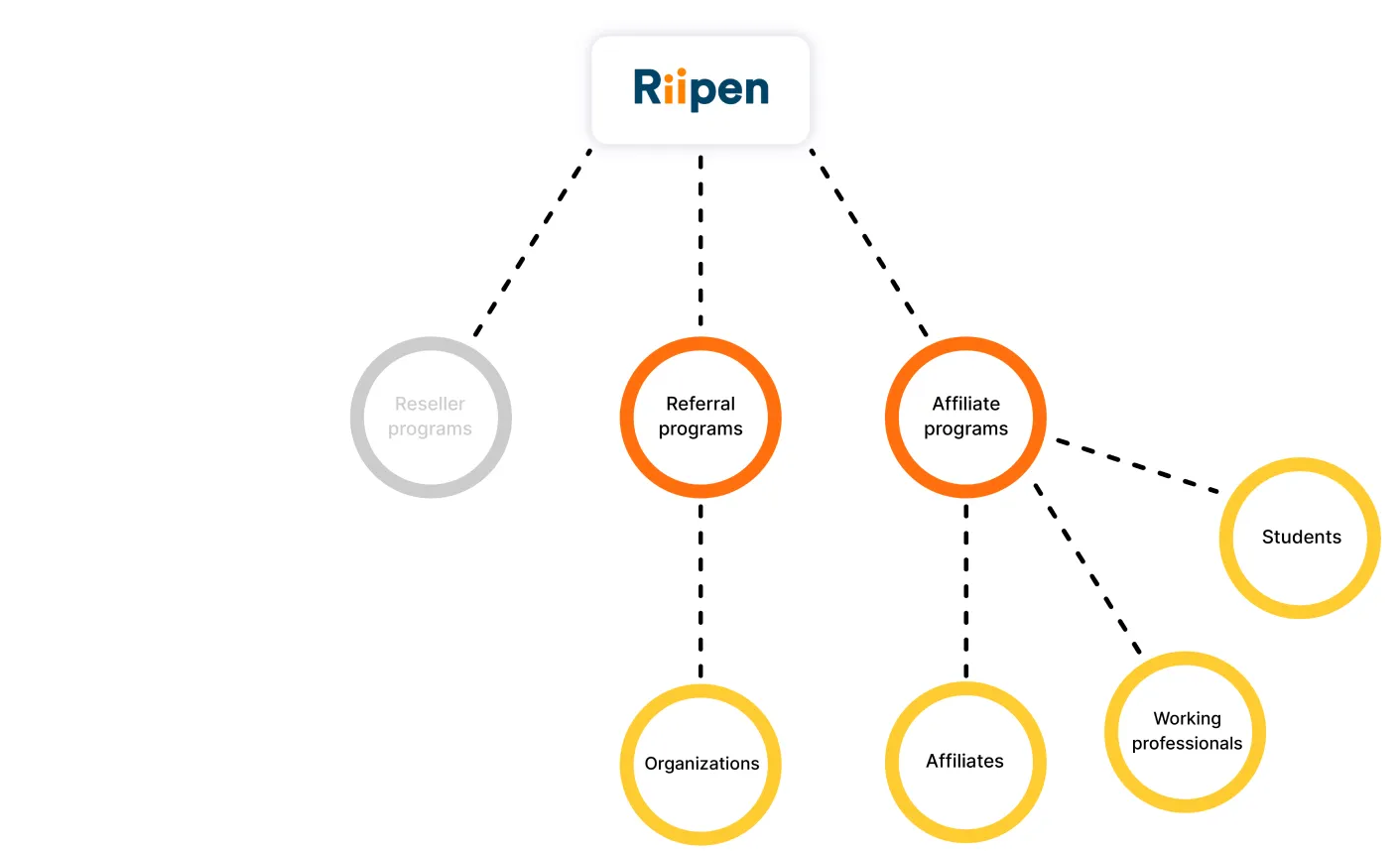
You can also have multiple personas within one program type. For example, Riipen, an experiential learning platform, describes four partner personas: legacy partners who started as customer advocates, student affiliates, company affiliates and default affiliates who found the program from PartnerStack’s Marketplace.
Related: Why partners don’t activate — and what that says about your program.
How is a partner persona different from an ideal partner profile (IPP)?
An ideal partner profile (IPP) describes your best-fit partner: AKA the traits most likely to succeed in your program. Partner personas describe each group of partners you work with, so you can tailor recruiting, onboarding and incentives to what each group needs. Some teams use the terms interchangeably, but the IPP works as a filter for who you recruit, while personas work as a playbook for how you support each group. PartnerStack AI, for example, can recruit continuously against an IPP you define once.
Why should you start with your target audience?
Start with your target audience, because your partners are how you reach it. Knowing who you’re trying to reach tells you which kinds of partners can get you in front of them. A target audience is a specific group of people for whom your product or service is designed. To truly grasp who your target audience is, you need to gather data about their roles, company types, behaviors, needs and pain points.
Once you have gathered the data, start identifying patterns and trends that will help you create a clear picture of your target audience. This picture should include details such as job roles, industries, company sizes, goals and the problems they’re trying to solve. Additionally, understanding their behaviors — such as how they use your product or service, what features they like or dislike and what motivates them to make a purchase — is essential. So is knowing where they go for advice before they buy: review sites, newsletters, podcasts, communities and, increasingly, AI tools. G2’s March 2026 survey of 1,076 B2B software buyers found that 51 per cent now start their research with an AI chatbot more often than with Google. That’s one more reason to look at the third-party sources your audience already trusts.
Your target audience is who you sell to. Your partner personas describe the partners who help you reach them, so a deep understanding of the first is the foundation for the second.
See more: Answer engine optimization for SaaS: The partner-led playbook for LLM recommendations.
Why are partner personas important?
The reason you need partner personas is simple: each type of partner wants and needs different things to be successful. Partner personas act as a cheat code to help you recruit new partners effectively and give each group the support they need to become active participants in your program.
Teamwork, for example, has given new partners separate quick-start guides for affiliates and agencies and emailed them a few days after they joined to explain Teamwork’s ideal customer profile and why customers in that audience were four times more likely to convert.
What’s more, understanding how you can best support each persona will ensure that you’re directing your resources into the groups that are most likely to succeed. If you don’t understand your personas in-depth, you risk putting your efforts into partners that won’t give you a return on your investment. These personas should be derived from actual partner research to authentically represent the needs and behaviors of real partners. They are also an excellent resource for interdepartmental collaboration because they communicate your vision to others in the organization.
Finally, slowing down to document your personas and make sure you’re serving each effectively builds a solid foundation for scale later. One of the biggest mistakes is adding new program types to “save” a struggling program. If your program is built on a faulty foundation, all the expansion in the world won’t help. You need to step back and figure out first how to make your original program resonate with partners. Only then can you effectively branch out into new program types.
What data do you need to build partner personas?
Data plays a pivotal role in creating personas. It helps identify patterns and trends that form a clear picture of your partners.
There are two types of data used in creating personas: qualitative and quantitative. Qualitative data is gathered through methods like interviews, focus groups and surveys, providing insights into the behaviors, needs and pain points of your partners. Quantitative data, on the other hand, is collected through your PRM and analytics tools and offers information about how your partners perform, such as clicks, signups, revenue and activity.
To create effective personas, it’s essential to combine both qualitative and quantitative data. This combination provides a comprehensive understanding of your partners, helping you create personas that accurately represent them.

How do you create partner personas?
There are a few steps to creating your own partner personas: identify your partner types, research them intently, synthesize your findings, distribute internally and continuously refine. We’ll explain each step in detail, with examples.
How do you identify your partner types?
Through data analysis
For some partner programs, there may be obvious groupings that distinguish your types of partners. For example, if you have one group of technology partners and another group of marketing partners, it’s an easy split.
For other partner programs, however, it’s less clear cut. If this is the case, you may decide to begin your program with one large group, and let segments emerge organically over time. Then you’ll identify them through your analytics.
If you’re using a modern PRM tool like PartnerStack, you can group and filter performance data by partner group, join date and source, such as the PartnerStack Marketplace versus external sources, to see which factors make partners more effective. In this way, you can leverage the data around your existing partner base to create segments for you.
Crunching the data can also help you identify your top performing partners. Partner-sourced revenue, average deal size and time-to-close are good metrics to start with. Identifying these individuals will be extremely important for the next step — the research phase — where you can uncover insights about these ideal partners that you can mold your recruitment strategy around.
Using AI
If you don't already have existing data about your partners — or if you want to skip some of the manual work — you can use AI tools to jump start your partner persona creation. Ola Ogungbemile, then a CSM at PartnerStack, shared his prompt sequence to build your partner personas:
- Define your business and the problem your product solves. Prompt with your level of experience, business area and who your target audience is.
- Create partner persona(s) based on the target audience. Ask your chosen AI tool to identify and describe two or more partner personas based on your target audience. Ask it to provide a comprehensive description and real-world examples of each partner persona.
- Bonus: identify potential partners for each persona. Prompt your chosen AI tool to find 20 potential partners, including their contact information, details about their potential audience and more. Format this in a summary table for easy review later.
Treat the output as a first draft. AI tools can invent partners and contact details, so check each name before you reach out and test the personas against partner data.
PartnerStack AI can help from there, ranking partners by performance, engagement and fit — and recruiting continuously against an IPP you define once.
See more: Dos and don’ts of using AI for your partner program in 2027.

How can you segment your partners?
Understanding your partners helps you distinguish your partner personas within one program type. Here are some typical ways to segment them.
- Type of organization (universities, agencies, SaaS companies)
- Job role (consultants, students, B2B influencers and content creators)
- Location (North America, LatAm and EMEA)
- Tier (silver, gold and platinum tiers — where higher sellers get a larger revenue cut)
- How they joined (the Marketplace, a direct invitation or a customer referral)
- Audience and content (publishers, reviewers, creators and communities)
When creating personas, you should also consider the level of knowledge that each group has about your offering. For example, customer ambassadors who love your product likely need lighter support than folks who come in from a wider, less qualified audience. Your ambassadors may just need marketing materials, whereas your external affiliates will need a lot more enablement and education.
Including a few illustrative details in these personas can enhance their realism and relatability, helping your team better understand each group's goals and limitations.
How do you research each partner persona?
During the partner research phase, your goal is to understand the individuals who make up each group: their stories, their motivations, their needs, their concerns. This process will build up your empathy and your ability to apply the ‘lens’ of each segment when you’re designing program touchpoints later. There are a variety of methods you can use to collect this information.
What research methods can you use?
- A series of 1:1 interviews with partners (especially top-performing partners)
- A survey you send out to partners (including both multiple choice and free form answers)
- A focus group you facilitate that brings multiple partners together for a discussion
- A series of discussions with your partner advisory council (PAC)
- An informal chat with members of your team who interface with partners regularly
When talking to partners one-on-one, you really want to understand the partner program from their perspective. Unlike surveys or analytics alone, these conversations give you a deeper, context-driven understanding. Think about the entirety of the partner journey when you design your questions, from recruitment to onboarding to promoting your products and services to payout.
What should you ask partners?
- How did you find out about our program originally?
- What enticed you to join? Did anything make you hesitate at first?
- What did you find confusing when you first got started?
- What are your biggest challenges or obstacles when promoting our product?
- What’s the most rewarding part of being a partner?
- What resources would help you more effectively sell our offering?
- If you could change one thing about our program, what would it be?
- Which other programs do you promote, and what makes you choose one over another?
- How does your audience research software today, including with AI tools?
If you’re lucky enough to get a handful of your top-performing partners on a call, pay particular attention to identifying the qualities and personality traits that make them ideal. This will make it easier to seek out other partners in the future who fit the profile.
How do you turn your research into a persona?
Next, you’ll want to boil down your research into a concise, persona-based summary. Having a clean, easy-to-read document will help you remember important insights and consistently apply them throughout the partner journey. Communicating your findings clearly is also helpful for distributing your partner personas throughout your organization.
For each persona, include a concise summary of:
- Their key motivators
- Their current challenges
- Their biggest needs
- A few verbatim quotes that help bring the profile to life
Get a head start with our partner personas template⟶
Who should see your partner personas?
Anyone who touches the partner journey: marketing, sales, leadership and product. While the main purpose of creating partner personas is for yourself and your own team, it can also be an extremely valuable tool for articulating your vision as you collaborate with other teams. It can serve as a concise overview that helps other team members get up to speed fast.
- Marketing: Your content team can support you by creating new or sharing existing collateral. Product marketing can give advance notice to partners for big product launches.
- Sales: Your sales team can share the sales enablement resources they use to train new salespeople, since this is not unlike resellers selling your product. You can either directly use their training materials or you can use them as a template and tweak to fit your purposes.
- Leadership: Display the value of your program to leadership to validate your efforts and justify asking for more budget.
- Product: Work with your development team to take your program further with technology integrations, such as connecting your PRM with your CRM.

When should you update your partner personas?
Your personas should be a living document that gets updated regularly, not just once. Update them whenever something changes, like your strategy, your incentives or how partners perform. After all, your partners are not static, so why should your program be?
It can be helpful to periodically survey partners to see what is and isn’t working, as well as uncover new risks and opportunities. Analytics can also help you refine how you address each partner persona as you troubleshoot their sticky points. Ask yourself, where is the drop-off? What enablement resources can you create or what campaigns can you run to address it?
You may also want to adjust incentives for various personas over time. For example, you may notice that customer ambassadors are more motivated by social status and swag, whereas affiliates are more motivated by a payout.
Business priorities shift, too. As your company’s overall strategy changes over time, you may want to beef up commissions for actions that are a higher priority for your company. For reference, our report, PartnerStack is Scaling Revenue Precision in 2026, found that top-performing vendors tend to offer commissions of 20 to 25 per cent.
What are the most common partner persona mistakes?
The most common mistakes are thin research, too many personas, outdated personas, personas nobody uses and personas built without input from other teams. Creating effective personas takes careful planning and execution, so here’s what to watch for:
- Not conducting thorough research: Personas are based on data collected from various sources. If the research is not thorough, the personas may not accurately represent your partners. Use real partner research in combination with AI tools, web searches and other methods to create meaningful, authentic insights.
- Creating too many personas: Having too many personas can be overwhelming and may dilute the clarity of who you’re recruiting and supporting. It’s better to create a few well-defined personas that accurately represent your partners.
- Not keeping personas up to date: Personas are not static and need to be updated regularly to reflect changes in your partners and your program. Failing to update personas can lead to inaccurate or outdated representations.
- Not using personas to design your program: Personas are created to help your team understand the needs and behaviors of each group of partners. If they are not used when you design onboarding, enablement, incentives and communications, they may not provide any value.
- Not involving stakeholders in the persona creation process: Personas need to be accepted by stakeholders to be effective. Involving stakeholders in the persona creation process ensures they are accepted and used across marketing, sales, product and leadership.
By avoiding these common mistakes, you can create effective personas that accurately represent your partners and help you build a program that meets their needs.
How do you use partner personas to grow your program?
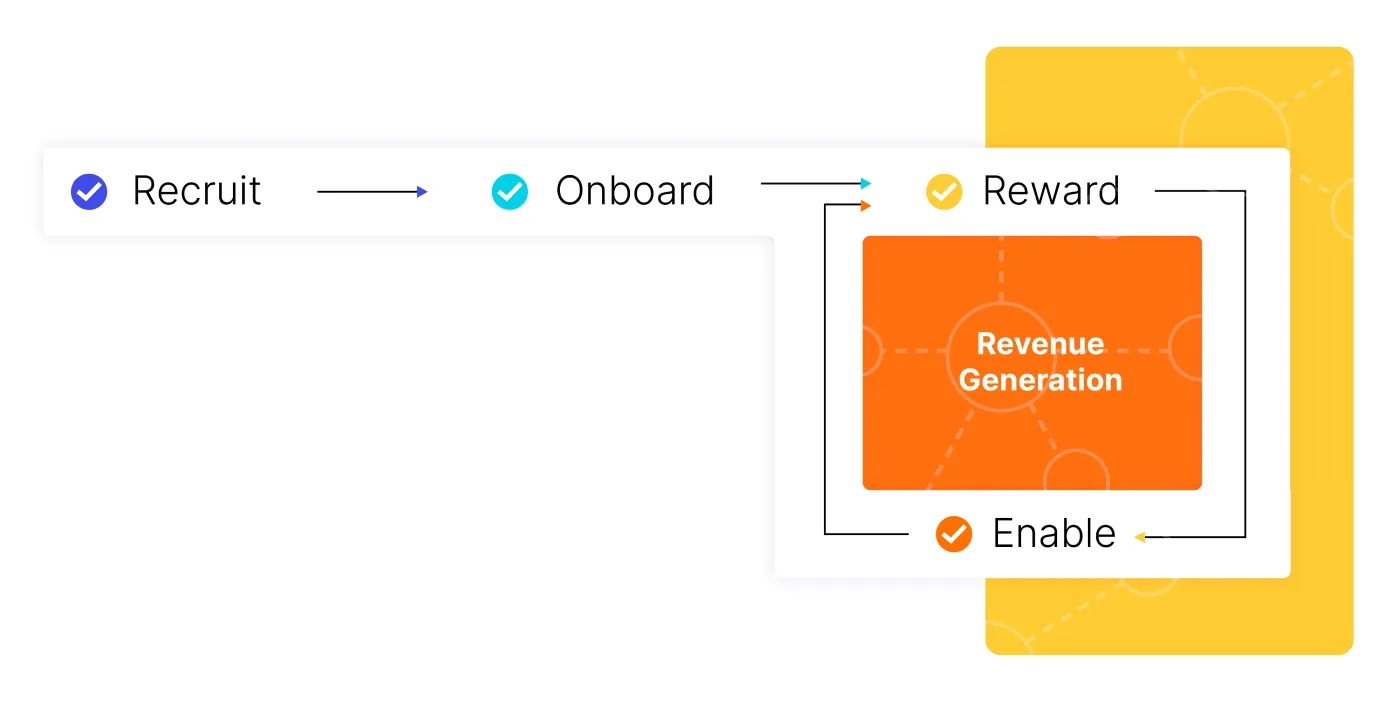
Apply them to every touchpoint in the partner journey, from recruitment and onboarding to enablement, incentives and payout. Once you’ve created well-researched partner personas and documented them in concise summaries, you have a clear lens you can use at each touchpoint.
It’s a valuable exercise to map out each point on their partner journey for each persona and apply the empathetic lens of each persona. Pretend you are from that group and ask yourself: “What’s in it for me?” Seeing each point through their eyes will help you optimize each step for a better partner experience and ultimately drive more conversions. Every email and every page of web copy should be written with your partner persona in mind.
Knowing your partners also means your communication will be seen as helpful and not interruptive. Many vendors are hesitant to send multiple emails to new partners in their first week, fearing they’ll come on too strong. But if each of these touchpoints is intentional messaging that speaks to something that a persona cares about, even a large volume of communication will be welcome.
How are partner personas changing?
Partner personas are changing in two ways: partner types are splitting into more groups, and AI is changing both how buyers research and how you find partners.
One of the key reasons to continue iterating on your partner personas is so they don't become outdated as industry trends shift. For example, affiliate partners may have had only one partner persona in the past, whereas today they could be bucketed into multiple partner persona types, like B2B influencers, content creators and review sites.
AI is a bigger shift. Our report, PartnerStack is Scaling Revenue Precision in 2026, found that 43 per cent of the citations AI models use to answer questions about top-performing vendors come from within the PartnerStack ecosystem. That makes the publishers and creators who cover your category worth defining as a persona of their own.
Partners are also using AI tools in their own workflows, and you can too: not just to automate routine tasks, but to find partners that match your personas.
Put your partner personas to the test
Ultimately, creating partner personas is all about refining your aim, so that every campaign and touchpoint is a bullseye. By understanding the goals, pain points and product usage of your partners, you can develop targeted strategies that align with their needs. Without partner personas, you may be wasting time launching arrows in the wrong direction. Better aim means better performance, no matter how many new personas or new program types you layer on.
While a variety of competing priorities may pull you away from creating partner personas, the old adage applies: Sometimes you have to slow down to speed up.
It pays to take a step back and ensure that every touchpoint caters to your partners’ motivations, enables their success and helps them overcome their hurdles. If you can do that, you’ll have your partners in the palm of your hand. And whether you’re a partner marketer or a stand-up comic, that’s no joke.
Partner persona FAQs
What is a partner persona?
A partner persona is a research-based profile of one group of partners you work with: their motivations, challenges and needs, so you can recruit the right partners and support them so they stay active participants in your program.
What should a partner persona include?
Each persona should cover the group’s key motivators, current challenges and biggest needs, plus a few verbatim partner quotes.
How many partner personas do you need?
It’s fine to start with one. If you run more than one partner program, such as an affiliate program and a referral program, you’ll need at least one persona for each. Too many can blur who you’re recruiting and supporting.
How is a partner persona different from an ideal partner profile (IPP)?
An ideal partner profile (IPP) describes your best-fit partner. Personas describe each group of partners you work with. Some teams use the terms interchangeably, but the IPP works more like a filter for who you recruit, and personas work more like a playbook for how you support them.
Where do you start when building partner personas?
Start with your data. Look at partner performance by group, join date and source, and find your top performers. Then interview those top performers to see what makes them ideal. If you don’t have partner data yet, AI tools can help you draft a starting point.
How often should you review partner personas?
Regularly, not just once. Update them whenever something changes, such as your strategy, your incentives or how partners perform. Surveys and analytics will show you what needs updating.
Editor’s note: This article was originally published in September 2021.